


PETER OBI’S ANAMBRA LEGACY UNDER SCRUTINY AS GOVERNMENT RAISES FRESH QUESTIONS OVER DEBTS, ARREARS AND ₦2.13BN FUND

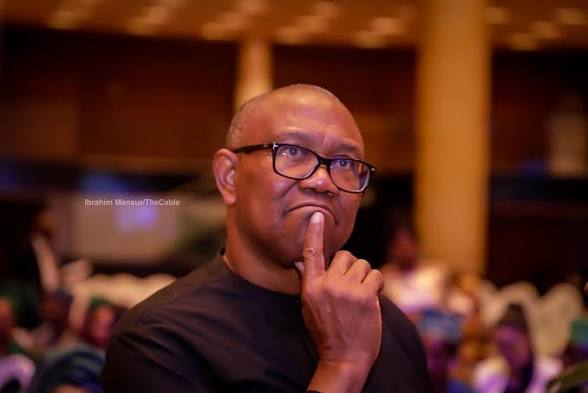
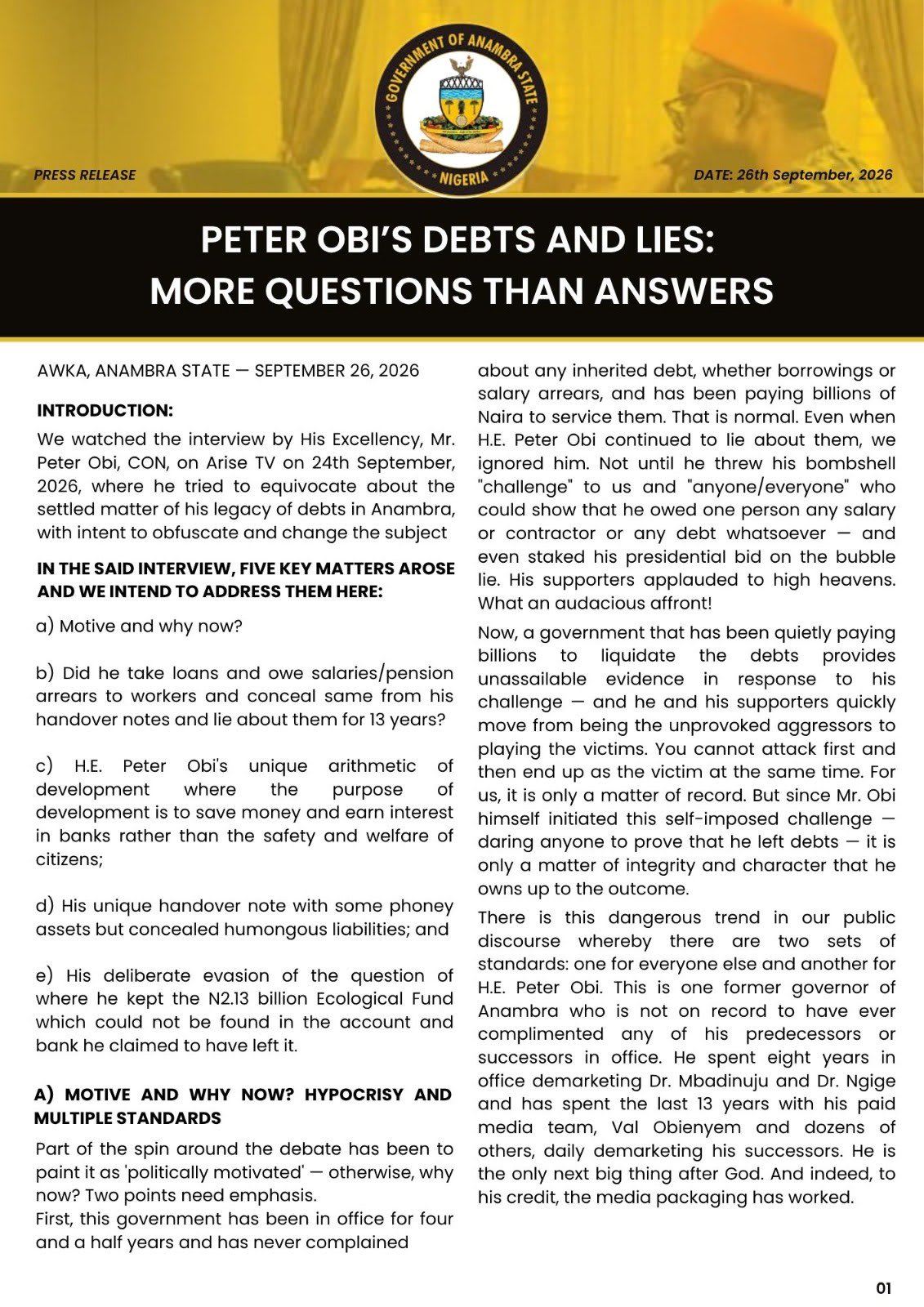
The Anambra State Government has renewed its public dispute with former Governor and 2027 presidential candidate Peter Obi following his September 24, 2026 interview on ARISE News, where he rejected claims that his administration left the state with outstanding debts and unpaid obligations.
In a strongly worded statement issued on September 26 by the Commissioner for Information and Value Reorientation, Dr. Law Mefor, the state government titled its response “Peter Obi’s Debts and Lies: More Questions Than Answers.” The government said it was responding to what it described as a challenge from Obi to produce evidence of debts or unpaid obligations allegedly left behind when he handed over power in March 2014.
Obi, during the ARISE News interview, maintained that he left Anambra in a strong financial position, insisting that he did not personally approach financial institutions to borrow money or issue bonds on behalf of the state. He also said his administration left more than $150 million in funds and investments and did not owe salaries, pensions, gratuities or verified and certified contractors at the point of handover.
The Anambra government, however, disputes that account and says official records tell a different story.
Dispute Over $123.77 Million World Bank/IDA Loans
One of the central issues in the controversy is the treatment of eight external loan facilities allegedly signed during Obi’s tenure.
According to the Anambra State Government, the eight IDA/World Bank facilities signed during the period amounted to $123,771,179.30. It further cited Debt Management Office figures showing that as of June 30, 2026, an outstanding balance of about $92.35 million, valued by the state at approximately ₦127.37 billion, remained payable.
The government said successive administrations have continued to service the obligations through deductions from the state's Federation Account allocations.




Obi's response is that the facilities were concessionary development support obtained by the Federal Government and on-lent to qualifying states for specific projects.
He argued that the way the loans are being attributed to his administration amounts to what he called “wrong public accounting.”
He also said that some of the facilities had not been substantially drawn down during his tenure and therefore should not simply be presented as money borrowed and spent by his administration. Obi further stated that Anambra's foreign debt position was about $18 million when he assumed office and approximately $30 million when he left in March 2014.
The state government rejects that explanation, arguing that the relevant subsidiary loan agreements were signed by the Anambra government and that the existence of assets or savings does not erase liabilities from a government balance sheet.
The ₦150 Million Savings Argument
Another major point of disagreement concerns Obi's claim that he left more than $150 million in state funds and investments.
Obi argued that even if the state had inherited the alleged debt, the funds he left behind were sufficient to cover it. According to his explanation, the investments were generating income and could have been retained while the returns were used to service the loans.
The former governor therefore maintains that presenting the alleged loan obligations without simultaneously considering the funds and investments he says he left behind gives an incomplete picture of Anambra's financial position.
The state government, however, says the existence of assets does not mean liabilities can be omitted from a handover document.
It alleges that Obi's handover documentation presented substantial assets while failing to adequately disclose liabilities associated with projects and contracts.
Among the claims made by the government is that contracts covering 101 roads totalling 779 kilometres had outstanding liabilities allegedly amounting to about ₦127 billion at the time of handover.
These figures are part of the state government's account and have not been independently established by the sources reviewed for this report.


Water Corporation Workers and Pension Arrears
The dispute also extends to workers' salaries, pensions and gratuities.
Obi told ARISE News that his administration did not owe salaries, gratuities or pensions to workers scheduled to be paid by the state government. He also argued that the Anambra State Water Corporation was an agency and not part of the government's regular payment schedule in the manner being suggested.
The state government disputes this.
According to Commissioner Mefor, more than 700 workers of the Anambra State Water Corporation had outstanding salary, pension and gratuity claims.
The government cited an arbitration process and a 2019 National Industrial Court judgment as evidence supporting the workers' claims. It further said the Soludo administration reached an out-of-court settlement with the affected workers in February 2024 for approximately ₦1.56 billion, of which about ₦1.20 billion had reportedly been paid.
The government also raised the issue of pension arrears involving primary school teachers, alleging that 11 months of arrears remained outstanding. It said the arrears originated partly from an earlier administration and that Obi's government had paid only a portion of the certified arrears.
Questions Over the Alleged ₦2.13 Billion Ecological Fund
Perhaps the most specific question raised in the latest government statement concerns an alleged ₦2.13 billion ecological fund.
Obi had previously stated that more than ₦2.13 billion was left in a First Bank account when he handed over power on March 17, 2014, and identified an account number in support of the claim. He said the money had been deliberately preserved for a specific erosion-related project rather than spent before his departure.
The Anambra government now says the account identified by Obi does not support that description.
According to the government's statement, First Bank, in a letter dated September 16, 2026, allegedly confirmed that the account referenced by Obi was an Anambra State Government Internally Generated Revenue Consolidated Account, rather than an ecological fund account.
The government further claimed that the account did not have a balance or inflow of ₦2.13 billion at the relevant time and questioned the whereabouts of the money Obi said he left behind.
That allegation is significant because it presents a specific, independently verifiable question: Was the ₦2.13 billion actually in the account identified by Obi on March 17, 2014, and, if so, what happened to it afterward?
A definitive answer would require examination of the underlying bank statements and relevant government financial records.
Why the Controversy Has Intensified
The dispute has become more prominent because Obi has linked his public defence of his Anambra record to his political career ahead of the 2027 presidential election.
In earlier comments, Obi challenged critics to prove that he left Anambra owing salaries, pensions or other debts, saying he would stop campaigning if evidence established the claim.
Following his ARISE News interview, the Anambra government said it was taking up that challenge by putting forward figures concerning loans, workers' claims, contractual obligations and the disputed ecological fund.
Obi, meanwhile, has called for the relevant records to be published and independently verified. During the interview, he specifically pointed to his handover documents and urged journalists and institutions to verify the financial figures with banks, the World Bank and other relevant agencies.
A Matter That Now Requires Documentary Verification
At the heart of the controversy are therefore two competing accounts.
Obi's position is that he left Anambra financially strong, with substantial savings and investments, without unpaid salaries or certified contractor obligations, and that the World Bank-related facilities have been mischaracterised as debts personally incurred by his administration.
The Anambra government's position is that Obi's administration signed the relevant loan agreements, left outstanding liabilities, owed certain categories of workers and failed to properly account for some obligations and the alleged ecological fund.
The competing claims make the availability and independent examination of primary documents particularly important. These include the Debt Management Office loan records, subsidiary loan agreements, disbursement records, Anambra's audited financial statements, the 2014 handover documents, court and arbitration records, and the relevant First Bank statements.
Until those documents are independently reconciled, the political argument is likely to continue producing competing narratives.

Share this story
More to Read
We Won’t Follow Atiku’s Path – APC Campaign Council Reacts To ‘Bola’ Remark
All Set for 2026 Youth Leadership Summit as NYC Oyo Chapter Announces Planning Committee
INEC Final List: Akinwale Olusayo Michael Congratulates KTJ, Elege, Other ADP Candidates Ahead of 2027 Elections
Stop Blaming Us – APC Tackles PDP Over Adebutu’s Exclusion From INEC List
Ogun 2027: PDP’s Adebutu Missing As INEC Releases Final Candidates’ List

Comments (0)
Want to join the discussion?
or