



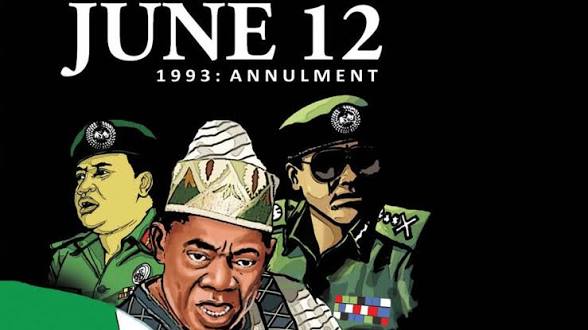
June 12, 1993: The Election That Changed Nigeria's Democratic History
June 12, 1993, remains one of the most defining moments in Nigeria's political history. More than three decades later, the date continues to symbolize the struggle for democracy, justice, and the right of Nigerians to freely choose their leaders. The events surrounding the June 12 presidential election shaped the nation's democratic journey and remain a reference point in discussions about governance and political accountability in Nigeria.
Background: Nigeria Under Military Rule
Before the June 12 election, Nigeria had spent much of its post-independence history under military governments. In August 1985, General Ibrahim Babangida seized power through a military coup and promised a transition to democratic rule.
Over the years, Babangida's administration initiated several political reforms and repeatedly postponed the handover to a civilian government. Political parties were dissolved and reconstituted, and eventually the government created two political parties:
The Social Democratic Party (SDP)
The National Republican Convention (NRC)
The arrangement was designed to guide Nigeria back to democracy after years of military rule.
The Presidential Election
The presidential election was held on June 12, 1993.
The SDP nominated Moshood Kashimawo Olawale (M.K.O.) Abiola, a wealthy businessman, philanthropist, and respected national figure. His running mate was Babagana Kingibe.
The NRC fielded Bashir Tofa with Sylvester Ugoh as his running mate.
What made the election remarkable was the level of national unity it inspired. Nigerians voted across ethnic, religious, and regional lines. Abiola, a Yoruba Muslim from the South-West, received support from all parts of the country, including the North, while Tofa, a Northern Muslim, also attracted support nationwide.
The election was conducted using the "Option A4" voting system, where voters openly queued behind the candidate of their choice. The process was widely praised for its transparency and credibility.
Domestic and international observers described the election as one of the freest and fairest ever conducted in Nigeria.
The Annulment
As election results began to emerge, it became clear that M.K.O. Abiola was heading for victory.
However, on June 23, 1993, the military government unexpectedly annulled the election before the final official declaration of the results.
The announcement shocked Nigerians and triggered widespread anger across the country. Many believed the annulment was an attempt by powerful interests within the military establishment to prevent a democratic transfer of power.
The decision was heavily criticized by civil society groups, political leaders, international observers, and ordinary citizens.
Nationwide Protests and Political Crisis
Following the annulment, Nigeria entered a period of political uncertainty and unrest.
Pro-democracy organizations, labour unions, students, journalists, and activists organized demonstrations demanding that the election results be restored and that Abiola be recognized as the winner.
The South-West region became the epicenter of many protests, although opposition to the annulment spread nationwide.
The political crisis deepened as the military government struggled to contain public dissatisfaction.
Babangida Steps Aside
Under mounting pressure, General Ibrahim Babangida announced on August 26, 1993, that he would "step aside" from power.
He handed authority to an Interim National Government headed by Ernest Shonekan.
However, the interim government lacked legitimacy in the eyes of many Nigerians and was unable to resolve the political crisis.
Rise of General Sani Abacha
In November 1993, Sani Abacha overthrew the Interim National Government and took power.
Abacha's regime became one of the most controversial military administrations in Nigeria's history.
Political freedoms were restricted, opposition figures were detained, and pro-democracy activists faced intense pressure.
Abiola Declares Himself President
On June 11, 1994, one year after the election, M.K.O. Abiola publicly declared himself the lawful president of Nigeria based on the mandate he believed Nigerians had given him.
The military government viewed the declaration as a challenge to its authority.
Shortly afterward, Abiola was arrested and charged with treason.
His detention became a major symbol of the struggle for democracy in Nigeria.
The Sacrifices of Pro-Democracy Activists
The June 12 struggle produced many heroes and martyrs.
Journalists, activists, students, labour leaders, and politicians risked imprisonment, exile, and even death while campaigning for the restoration of democracy.
Among those associated with the struggle was Kudirat Abiola, who became one of the strongest voices advocating for her husband's mandate. She was assassinated in Lagos in 1996.
Her death intensified local and international condemnation of military rule.
The Death of Abiola
A major turning point came in 1998 when General Sani Abacha died suddenly on June 8.
One month later, on July 7, 1998, M.K.O. Abiola also died while in detention under circumstances that generated widespread controversy and national grief.
Many Nigerians viewed his death as the ultimate sacrifice in the struggle for democratic governance.
Return to Democracy
Following the deaths of Abacha and Abiola, General Abdulsalami Abubakar initiated a new democratic transition process.
The process eventually led to the election of Olusegun Obasanjo and the return of civilian rule on May 29, 1999.
Although democracy was restored, many Nigerians continued to demand official recognition of the June 12 election and the mandate believed to have been won by Abiola.
Recognition of June 12
For many years, June 12 was commemorated mainly in the South-West and among democracy activists.
In 2018, President Muhammadu Buhari officially recognized M.K.O. Abiola as the presumed winner of the 1993 election and posthumously awarded him Nigeria's highest national honour, the Grand Commander of the Federal Republic (GCFR).
The federal government also declared June 12 as Nigeria's official Democracy Day, replacing May 29.
Legacy of June 12
Today, June 12 stands as a symbol of:
The power of the people's vote.
The struggle against oppression and military dictatorship.
National unity beyond ethnic and religious divisions.
The sacrifices of pro-democracy activists.
The enduring quest for accountable leadership and good governance.
The story of June 12, 1993, is not merely about an election. It is the story of a nation determined to defend democracy, honor the will of its people, and ensure that future generations never forget the sacrifices made for freedom and democratic governance.
"June 12 is more than a date in Nigeria's history—it is a symbol of the people's mandate, the price of freedom, and the enduring spirit of democracy." 🇳🇬
Share this story
More to Read
We Won’t Follow Atiku’s Path – APC Campaign Council Reacts To ‘Bola’ Remark
All Set for 2026 Youth Leadership Summit as NYC Oyo Chapter Announces Planning Committee

INEC Final List: Akinwale Olusayo Michael Congratulates KTJ, Elege, Other ADP Candidates Ahead of 2027 Elections
Stop Blaming Us – APC Tackles PDP Over Adebutu’s Exclusion From INEC List
10 Major Highlights From Tinubu’s Independence Day Address

GLOBAL RECOGNITION: Jubril Dotun Sanusi Hails Amb. Kunle Yusuff’s Representation of Nigeria at UN Headquarters
Shettima Departs Abuja To Angola For AU Summit

Comments (0)
Want to join the discussion?
or